


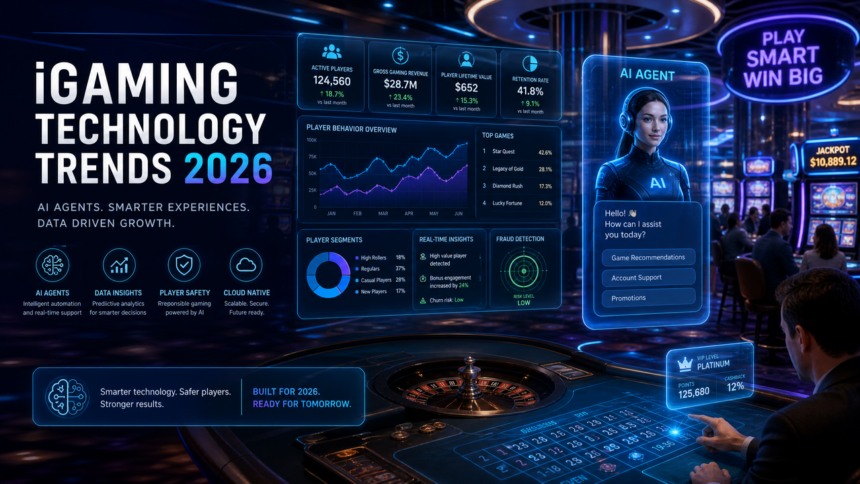
AI Agents Fuel Real-Time iGaming Personalization
In 2026, the global iGaming industry is being reshaped by two converging forces: autonomous AI agents, and hyper-fast, **real-time personalization**. Operators, suppliers, and regulators are navigating a landscape where decisions that used to take hours now happen in milliseconds. The result is tighter operations, faster responses to risk, and player experiences that feel bespoke.
Why AI Agents Matter Now
AI agents are software entities that act on behalf of operators, making repeated, data-driven choices across front- and back-office functions. They handle dynamic pricing, targeted offers, session-level recommendations, and even real-time risk scoring. The term is more than a buzzword, it signals a shift from static rules to autonomous systems that learn, adapt, and execute.
For operators, the immediate appeal is efficiency. Tasks that required manual review, or rigid rule-sets, are now automated. That lowers costs, speeds reaction times, and reduces human error. For suppliers, embedding agent-capable APIs into wallets, loyalty platforms, and game engines opens new monetization paths.
Operational Gains and Market Impact
Adoption of agent-driven workflows improves throughput across onboarding, payments, and dispute resolution. It also tightens fraud and risk controls, because agents can correlate multiple signals in real time. In markets crowded with competition, those gains translate into measurable advantages in acquisition cost and player retention.
Regulators are taking notice. Where transparency and auditability exist, regulators have warmed to automated controls. Where systems are opaque, regulators push back and demand explainability. That tension is a key battleground for 2026.
Real-Time Personalization – The Player Experience
Real-time systems use continuous data streams to modify offers and odds at session-level granularity. Players now receive promotions, UI tweaks, and game suggestions tailored to their immediate behavior. That drives longer sessions and higher lifetime value, but it raises ethical and regulatory questions around consent and harm minimization.
Technically, successful personalization rests on two pillars: low-latency data infrastructure, and robust model governance. The first relies on distributed event streaming, edge compute, and optimized CDNs. The second demands model validation, monitoring, and human oversight.
Fraud, Compliance Automation, and Explainability
One of the biggest near-term wins is in compliance automation. Agents can perform continuous KYC rechecks, flag suspicious patterns, and trigger safe-play interventions in real time. They reduce manual case loads, but not regulatory responsibility. Firms must ensure systems are auditable, and that automated decisions can be explained to both players and regulators.
Explainability is not optional. As models influence wagers, payouts, and account status, operators must maintain logs, decision trees, and fallback procedures. Human-in-the-loop controls remain critical for high-stakes outcomes.
Risks, Governance, and the Vendor Ecosystem
AI agents and personalization introduce new risks. Model drift, biased outcomes, and supply-chain vulnerabilities can cause reputational and financial harm. Vendors marketing turnkey agent platforms must prove they offer transparent model cards, rigorous third-party audits, and robust security.
Operators need a clear governance framework. That includes model risk assessments, performance SLAs, and cross-functional oversight from compliance, product, and data science teams.
Practical Recommendations
- Prioritize explainable models, and maintain detailed decision logs for auditability.
- Deploy agents incrementally, with human oversight on critical flows like payments and account closures.
- Invest in low-latency infrastructure, edge compute, and resilient streaming to support real-time personalization.
- Engage regulators early, and document compliance controls to reduce friction during market entries.
AI agents and real-time personalization are not futuristic concepts, they are active drivers of competitive advantage in 2026. Firms that balance innovation with governance will win market share and avoid costly regulatory setbacks. The rest will learn the hard way that automation without transparency is still a liability.