

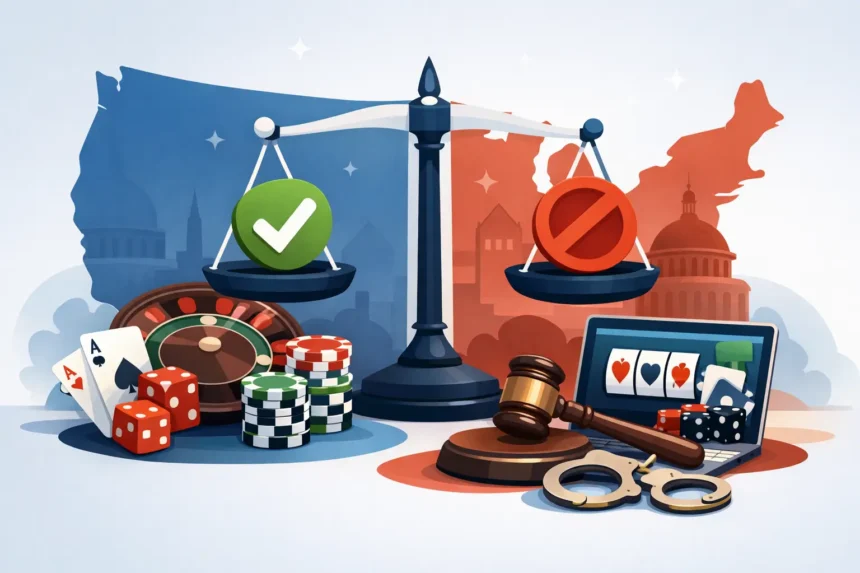
A casino app works perfectly fine on your phone in New Jersey, but the same app can be off-limits the moment you cross into another state. That gap is why so many players keep asking the same question: is online gambling legal? The short answer is yes in some places, no in others, and often only for certain products. In the US, legality depends less on the internet itself and more on where you are, what you are playing, and who is offering it.
- Is online gambling legal? It depends on the state
- What counts as online gambling?
- Why the law is so fragmented
- Legal markets vs offshore sites
- How states decide whether online gambling is legal
- What makes an online gambling site legal for players
- Is online gambling legal if you travel?
- The payment angle players overlook
- Where US law may head next
Is online gambling legal? It depends on the state
The biggest mistake players make is treating online gambling as one national market. It is not. The US has a patchwork system where each state decides whether to allow online sports betting, online casino games, poker, horse racing, or lottery products.
That means a state can approve one form of online wagering while banning another. New York is a good example. Mobile sports betting is legal there, but online casino games are not. New Jersey, on the other hand, allows a much broader menu that includes online slots, table games, and poker alongside sports betting.
From a player perspective, this creates a legal map that changes by category. Asking whether online gambling is legal without naming the product is like asking whether driving is legal without mentioning the speed limit. The context matters.
What counts as online gambling?
For most readers, online gambling covers a few distinct buckets. Online sports betting is one. Online casino gaming includes slots, blackjack, roulette, baccarat, and live dealer tables. Online poker sits in its own lane because some states regulate it separately. Then there are daily fantasy sports, advance-deposit wagering on horse racing, and state lottery apps, each with their own legal treatment.
This matters because lawmakers do not always regulate these products together. A state legislature might be comfortable with sports betting because it tracks the post-PASPA wave, while still opposing online slots because of political pressure from land-based casinos or anti-gambling groups. So if you are trying to assess risk, start by defining the product before you look at the law.

Why the law is so fragmented
The core reason is federalism. States control most gambling policy inside their borders, and they do not agree on the right model. Some want open, taxed, licensed markets. Some prefer retail-only gambling. Others want no legal market at all.
Federal law still matters, but mostly in the background. The Unlawful Internet Gambling Enforcement Act, or UIGEA, does not simply ban all online gambling. What it mainly does is restrict financial transactions tied to unlawful internet gambling. That sounds technical, but it has real effects. It influences how banks, card issuers, and payment processors treat gambling deposits and withdrawals.
The Wire Act also comes up often, usually with more confusion than clarity. It was originally aimed at interstate sports betting communications. Over time, its interpretation has shifted through court fights and government opinions. For most players, the practical point is simpler: states want gambling activity contained within state lines unless a specific legal framework says otherwise.
Legal markets vs offshore sites
This is where the question gets sharper. In a regulated state, legal online gambling usually means the operator is licensed by a state gaming regulator, follows local rules, verifies age and location, and offers some level of consumer protection. That includes dispute procedures, responsible gambling tools, and tested games.
Offshore sites live in a different category. They may accept US players, advertise aggressively, and look polished, but that does not make them legal under state law. In many cases, they are operating outside the US regulatory system entirely. Players are then relying on the site’s own promises rather than a state regulator with actual enforcement power.
That distinction matters more than bonus size or game count. A licensed operator can lose its market access if it breaks the rules. An offshore site does not face the same pressure. If there is a payout dispute, an account closure, or a game fairness question, your options are thinner.
How states decide whether online gambling is legal
Most states look at the issue through a mix of tax revenue, political appetite, tribal gaming relationships, land-based casino interests, and public opinion. That is why legalization rarely moves in a straight line.
A state with a strong commercial casino industry may support online expansion if it protects existing operators. A state with significant tribal gaming compacts may need a more delicate legislative approach. Some lawmakers back sports betting because it feels easier to sell politically, then stop short of online casino legislation because casino gaming is seen as a bigger step.
That is also why there is no fixed timeline for nationwide expansion. Momentum exists, but so does resistance. Legalization tends to happen when budget pressure, industry lobbying, and political timing line up.
What makes an online gambling site legal for players
If you are trying to figure out whether a platform is legal where you live, there are a few signs that matter more than branding.
First, the site should clearly identify its state license. In regulated markets, operators are not vague about this. They usually name the licensing authority and the state where they are approved to operate. Second, the platform should use geolocation technology. If a site lets you place bets from anywhere without checking your location, that is a red flag in the US market. Third, the registration process should require identity verification and age confirmation.
This can feel inconvenient compared with offshore sign-ups, but that friction is part of the legal structure. Regulated gambling is supposed to know who you are, whether you are old enough, and whether you are physically inside the state.
Is online gambling legal if you travel?
Sometimes yes, sometimes no, and your home state does not control it. Your physical location at the time of play is what usually matters. If you live in a state without legal online casino gaming but travel to one that allows it, you may be able to play there once the app confirms your location.
The reverse is also true. If you normally use a legal betting app in a regulated state, that app may stop working when you travel to a non-regulated one. Players who assume account access equals legal access often get caught here. In gambling, geolocation is not a side feature. It is the gatekeeper.
The payment angle players overlook
One reason people ask whether online gambling is legal is because their bank blocks a transaction. That does not always mean the site is illegal, but it can signal how complicated the payment landscape remains.
Even legal operators sometimes face card declines because issuers classify gambling differently or take a cautious stance. E-wallets, online banking transfers, prepaid products, and cash-at-cage options often fill the gap in regulated markets. What matters is the overall setup. If a site pushes crypto-only deposits, avoids standard banking rails, and offers little transparency on withdrawals, that deserves scrutiny.
Payment friction alone is not proof of illegality. But in this sector, it often points to the difference between a regulated framework and a workaround.
Where US law may head next
The trend line favors more regulation, not less, but expansion will stay uneven. Sports betting opened the door in many states, and online casinos remain the bigger unresolved fight because they bring more revenue and more political pushback. Poker may continue to grow through shared liquidity agreements, but that will likely remain a niche story compared with casino and sportsbook growth.
For readers tracking the business side, the interesting shift is not just whether more states legalize. It is how they legalize. Expect continued debate over tax rates, skins per license, tribal participation, advertising restrictions, and responsible gambling requirements. Those details shape the player experience as much as the headline does.
So, is online gambling legal? In parts of the US, absolutely. But legal access is defined by state law, product type, operator licensing, and your physical location at the time you play. If you want the safest answer, skip the broad assumptions and check the market rules where your feet are actually standing. In gambling, that is often the difference between a regulated bet and a risky one.