

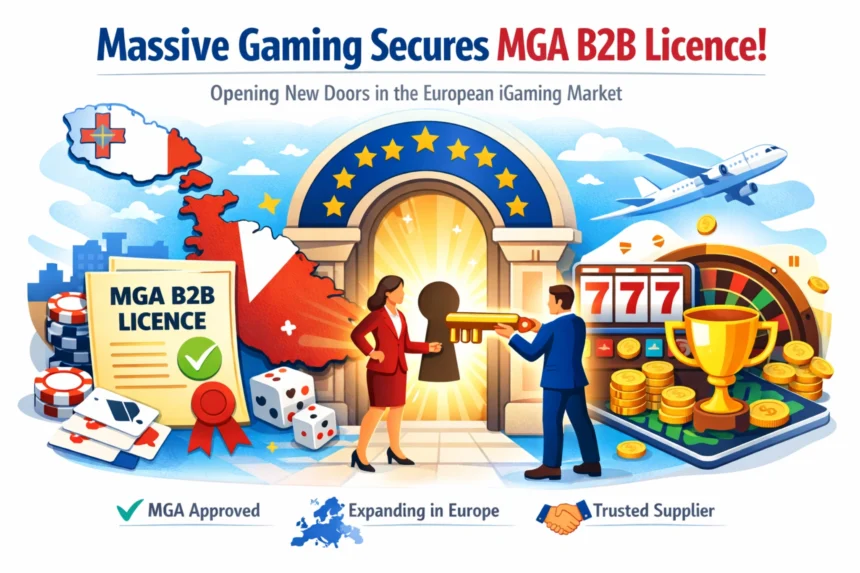
Massive Gaming has secured an MGA B2B licence, giving the supplier a more serious regulatory foothold in one of Europe’s most important iGaming jurisdictions. The approval was announced on 23 March 2026, with the company saying the licence will support its push for wider operator partnerships and market expansion.
That matters because Malta licensing still carries real weight across the European B2B ecosystem. An MGA B2B approval is not just a decorative badge for a supplier website. It signals that a company can operate under one of the region’s most recognized regulatory frameworks for game and platform supply, which remains commercially meaningful for operator due diligence, partnership talks, and cross-market credibility.
Why an MGA B2B Licence Still Matters
For suppliers, Malta remains one of the most practical and recognizable bases in European online gambling. The Malta Gaming Authority continues to oversee one of the continent’s most established licensing regimes, and its annual reporting shows that B2B licences remain a major part of the authority’s licensing mix.
That is why this kind of approval still matters even in a market now crowded with local certifications and national licences. Operators looking for new content or platform partners still tend to treat Malta approval as a useful trust marker, especially when comparing smaller or fast-growing suppliers. In plain English, it tells the market the company has made it through a serious regulatory gate rather than simply announcing global ambitions and hoping everyone is too polite to ask questions.
The business significance is also straightforward. Massive Gaming said the licence is intended to help it expand global iGaming partnerships, which is the usual next step after a B2B approval of this kind: more regulated-market conversations, more operator integrations, and a stronger position in commercial negotiations with partners that prefer licensed suppliers.

A Supplier Milestone With Broader European Relevance
The broader reason this story matters is that MGA approvals still function as a useful benchmark in Europe’s supplier market, even as the continent becomes more fragmented and country-specific on the B2C side. For B2B firms, Malta remains one of the clearest regulatory entry points into the wider European iGaming network.
That makes Massive Gaming’s approval more than a routine corporate update. It is a signal that the supplier is trying to move into a more serious regulatory tier, where licensing is part of the sales argument rather than a problem to solve later.
The bottom line is that Massive Gaming’s MGA B2B licence matters because Malta still counts. In Europe’s supplier ecosystem, that kind of approval remains one of the clearest ways to show regulatory seriousness, partnership readiness, and intent to compete on a bigger stage.