


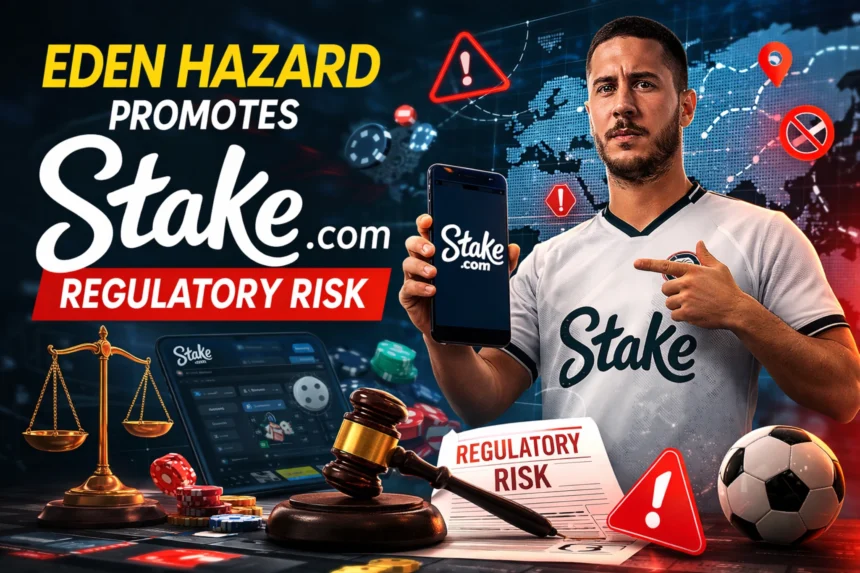
Belgium’s reported probe into Eden Hazard’s new ambassador deal with Stake is becoming a notable gambling-regulation story because it shows how a “global” sponsorship can still collide with very local advertising rules.
The issue is not that Hazard signed with a betting brand in the abstract. It is that Stake is not licensed in Belgium, and Belgian authorities are reportedly examining whether Hazard’s promotional activity could amount to advertising an illegal operator to Belgian users. That turns what might otherwise look like a standard celebrity-brand partnership into a regulatory test case.
In plain English, the message is this: calling an ambassador deal “global” does not magically remove local legal consequences if the content can still reach consumers in a restricted market.
Why the Hazard-Stake Deal Has Become a Regulatory Issue
The reported investigation centers on whether Hazard’s promotion of Stake was effectively targeting the Belgian market. Belgium’s Gambling Commission has said Stake is illegal there because it does not hold a valid domestic licence, and advertising illegal gambling services to people in Belgium is prohibited. That is why the regulator is not just looking at the existence of the partnership, but at how and where the promotion was distributed.
That distinction matters. A retired footballer becoming a global ambassador for a gambling brand is not unusual in itself. But when the ambassador is one of Belgium’s most recognizable sports figures, with a large domestic following and immediate brand recognition, the local-risk question gets much sharper. Regulators do not have to prove the campaign was designed only for Belgium to worry that it could still influence Belgian consumers.

This is also why the case has drawn attention beyond celebrity gossip value. It sits at the intersection of illegal-market enforcement, athlete endorsements, and cross-border digital advertising, which is one of the trickier areas in European gambling regulation right now.
The Bigger Problem: Global Campaigns, Local Rules
What makes the Hazard story more important than a one-off headline is the wider principle behind it. Gambling operators increasingly use former stars and active athletes to market themselves across multiple countries at once, usually through social media and international fan engagement campaigns. But gambling law does not work that way. Regulation remains largely national, sometimes even hyper-local in effect, and what is acceptable in one market can create liability in another.
That means ambassador deals now carry a more complicated compliance burden than they used to. It is not enough to sign a famous name and call the campaign international. Operators and ambassadors have to consider whether the content is visible in markets where the brand is restricted, blacklisted, or entirely illegal. If not, the “global ambassador” model starts to look less like a marketing strategy and more like a legal stress test.
For Belgium, this fits an already strict approach. The country has become one of Europe’s tougher jurisdictions on gambling advertising and unlicensed operator access, which makes any high-profile endorsement deal involving an unlicensed brand especially sensitive.
The bottom line is that Belgium’s reported investigation into Eden Hazard’s Stake deal matters because it highlights a growing tension in gambling marketing: international ambassador campaigns are easy to launch, but much harder to keep compliant across borders. If Belgian authorities conclude that Hazard’s promotion reached or targeted Belgian users, the case could become a warning shot not only for the player and the operator, but for the wider gambling industry’s reliance on celebrity endorsements in tightly regulated markets. In other words, the sponsorship may be global. The legal consequences usually are not.