

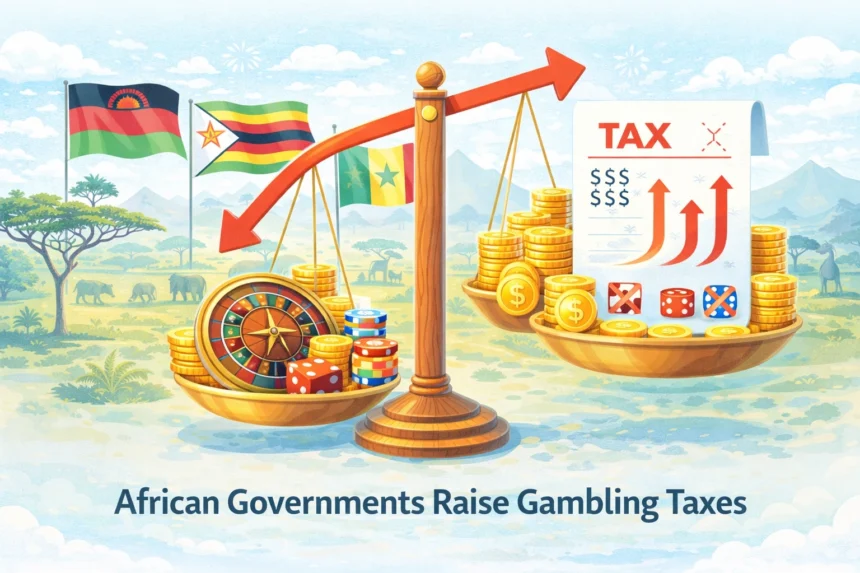
Africa has become the clearest same-day global gambling story because several governments are tightening tax pressure at once as online betting expands and addiction concerns worsen. Reuters reports that countries including South Africa, Malawi, Zimbabwe, and Senegal have either raised or tightened gambling-related taxes, turning the region into one of the busiest current flashpoints in gambling policy.
The biggest headline is South Africa, where the government is considering a 20% national tax on gambling profits. Reuters says the proposal is designed to boost public revenue and address the social fallout from a rapidly growing online betting market. In the same report, Reuters says South Africa’s online gambling participation has climbed sharply, with about two-thirds of adults now gambling online, up from 30% in 2017.
That matters because South Africa is not a fringe market. Reuters says gamblers there wagered a record 1.5 trillion rand in 2024/25, making it by far the largest gambling market covered in the current African tax story. The proposed tax could also have a major fiscal impact, with the government projecting that it would roughly double gambling-tax revenue to 10 billion rand a year.
South Africa Is Leading the Debate, but It Is Not Alone
The broader African picture is what makes this more than a local policy update. Reuters says Malawi, Zimbabwe, and Senegal have also tightened or increased gambling-related taxes as governments try to respond to the same mix of concerns: rising betting activity, worsening addiction risks, and the chance to pull more money into public finances.
That gives the story a wider significance. This is not one country improvising on gambling policy. It looks more like several governments arriving at the same conclusion at roughly the same time: online betting is growing fast enough that the state wants a bigger cut and stronger control.

The public-health angle is also becoming harder to ignore. Reuters reports that the South African Responsible Gambling Foundation treated 4,600 addicts in 2025, up from 2,600 in 2024, while helpline demand also increased. That helps explain why this debate is not being framed only as a tax story. It is also a harm-reduction story, or at least a government effort to present it that way.
Why the Industry Is Pushing Back
Industry groups are warning that higher taxes could backfire by making licensed operators less competitive and pushing bettors toward illegal platforms. Reuters says the South African Bookmakers’ Association has argued that, once other levies are included, the combined burden on legal operators could rise as high as 38.5%.
That is the core tension running through this story. Governments want more revenue and tighter control, but operators argue that higher taxes do not just squeeze profits. They can also make the legal market weaker at exactly the moment when illegal supply remains a serious risk. In markets where black-market gambling is already easy to access, that is not an abstract complaint. It is a real policy trade-off.
The bottom line is that Africa’s gambling-tax story matters because it brings together three forces at once: faster online betting growth, rising political concern about addiction, and a more aggressive state effort to capture revenue from the sector. With South Africa considering a major new national tax and Malawi, Zimbabwe, and Senegal also tightening the screws, the region has become one of the most active gambling-policy battlegrounds in the current news cycle.