

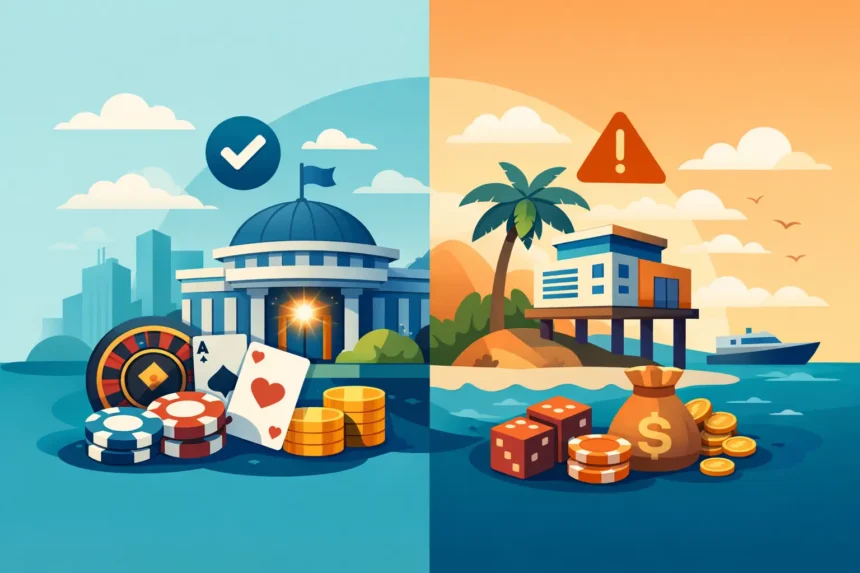
If a casino offers a bigger bonus, looser terms, and accepts your deposit in minutes, the sales pitch is obvious. The real question is what happens after the signup. That is where licensed casinos versus offshore sites becomes less of a marketing comparison and more of a risk calculation.
- Licensed casinos versus offshore sites: what changes in practice
- Why regulation matters when money is on the line
- Payment reliability is where the gap shows up fastest
- Bonus value is not always real value
- Licensed casinos versus offshore sites on game fairness
- The legal risk is different from the practical risk
- Who still uses offshore sites, and why
- How players should evaluate the choice
For US players, this gap matters more than ever. State regulation is expanding, offshore brands still target American traffic, and plenty of players are trying to figure out whether convenience and promo size are worth the trade-off. Sometimes the answer looks obvious. Other times, it depends on what kind of player you are, what state you live in, and how much risk you are actually taking on.
Licensed casinos versus offshore sites: what changes in practice
The headline difference is simple. A licensed casino operates under a recognized regulator in the market where it serves players, or in another approved jurisdiction with legal oversight, auditing, compliance rules, and dispute procedures. An offshore site usually operates from a foreign jurisdiction and takes players from places where it may not be expressly licensed to do business.
That legal distinction affects almost everything a player experiences. It shapes how games are tested, how funds are segregated, how identity checks are handled, how complaints are reviewed, and whether anyone can force the operator to act if something goes wrong.
A licensed operator has to protect its market access. That means rules around anti-money laundering, responsible gambling tools, age verification, and payment controls are not optional features. They are the cost of staying in business. Offshore sites may have some of those tools, but the standard is uneven and enforcement is often the missing piece.
Why regulation matters when money is on the line
A lot of gambling content focuses on front-end features – game selection, welcome offers, VIP perks, payment speed. Those things matter, but they matter less if your withdrawal gets delayed or your account is frozen after a win.

With licensed casinos, there is at least a system behind the product. Regulators can review complaints, impose fines, suspend licenses, and require operators to meet technical and financial standards. That does not mean every licensed brand is flawless. Players still run into slow support, strict verification, and frustrating bonus rules. But there is a framework that gives the customer some leverage.
With offshore sites, leverage is thinner. A site might pay quickly for months and still become a problem later. Terms can shift, limits can appear with little warning, and dispute channels may be vague or ineffective. If an offshore operator decides your activity triggered a rule buried in its terms, your options are often limited to arguing with support and hoping for a resolution.
That is the core issue. A gambling site is not just software. It is a counterparty holding your money.
Payment reliability is where the gap shows up fastest
For many players, trust is tested at cashout. Deposits are easy almost everywhere. Withdrawals reveal how serious an operator really is.
Licensed casinos usually work within known banking frameworks, approved processors, and compliance-driven payout procedures. That can feel slower on the front end because identity checks are stricter and source-of-funds questions may come up. But those checks are tied to rules the operator is expected to follow.
Offshore sites often market speed and flexibility. Crypto support is common, card options may look broad, and onboarding can feel lighter. That is attractive, especially to players who do not want friction. But less friction at signup can also mean less accountability later. If there is a payment dispute, a reversed bonus ruling, or a sudden document request after a large win, the player is dealing with the operator from a weaker position.
There is also the issue of banking stability. Payment channels available today may disappear tomorrow, especially when a site is serving customers in gray or restricted markets. If you are using an offshore site, every deposit method should be viewed not just as a convenience feature, but as part of the platform’s overall risk profile.
Bonus value is not always real value
This is where offshore brands often win the first impression. Bigger headline bonuses, fewer location checks, broader crypto promotions, and aggressive retention offers can make licensed options look conservative.
But bigger is not automatically better. Licensed casinos in regulated markets have clearer promotional standards, even if those standards vary by state. Terms still need scrutiny, especially around playthrough, game exclusions, max cashout caps, and time limits. The difference is that regulators can step in when promotions are misleading or unfair.
Offshore bonus offers can be genuinely competitive, but they can also be structured in ways that create more room for operator discretion. If an offer looks unusually generous, read the restrictions twice. A huge bonus tied to hard-to-clear wagering requirements or ambiguous abuse clauses is not really player-friendly. It is just loud.
Experienced gamblers know this already: the best bonus is the one you can use without fighting the rules.
Licensed casinos versus offshore sites on game fairness
Most players assume slots are random and table games are standard unless proven otherwise. That assumption is safer in regulated markets.
Licensed casinos generally use games from approved suppliers, with testing tied to jurisdictional requirements. Return-to-player data, certification, and game integrity standards are part of the ecosystem. Again, that does not guarantee a great experience or better luck. It does mean there is a documented compliance chain behind the product.
Offshore sites may carry games from legitimate providers, proprietary games, or a mix of both. Some are perfectly functional. Some are harder to verify. If a site offers unfamiliar software, very little transparency, or game libraries that seem disconnected from known suppliers, caution is warranted. The issue is not whether every offshore game is unfair. The issue is whether you can independently trust the system if a result or payout is disputed.
The legal risk is different from the practical risk
US players often ask whether using an offshore site is illegal. The answer depends on the state, the specific activity, and how local law is written and enforced. In many cases, enforcement attention is aimed more at operators than individual players. But that does not erase risk.
Practical risk usually matters more than abstract legal debate. If you use an offshore site from a state with regulated alternatives, you may be stepping outside the consumer protections available in your market. You may also run into tax reporting uncertainty, payment processing problems, or account issues that are hard to resolve cleanly.
That does not mean every offshore customer gets burned. Plenty of players use offshore platforms because they want market access their state does not provide, higher limits, crypto compatibility, or products not yet available locally. The demand is real. So is the trade-off.
Who still uses offshore sites, and why
The offshore market persists because it solves gaps. Some US players live in states without legal online casinos. Others want faster registration, fewer betting restrictions, broader sports or casino menus, or promotions that regulated operators cannot match.
There is also a familiarity effect. Many offshore brands have served US-facing customers for years, and some players trust them based on personal experience rather than licensing status. That trust may feel rational if someone has deposited and withdrawn without issue. But it is still personal trust, not regulatory protection.
That distinction matters most when conditions change. A site can look reliable right up until it is not.
How players should evaluate the choice
If you are comparing licensed casinos versus offshore sites, start with one question: what protection do you have if the operator acts against your interest?
After that, look at the basics. Check where the site is licensed, whether that license is relevant to your location, how transparent the terms are, how withdrawals are handled, and whether customer complaints follow a visible process. Review the bonus language, payment methods, and responsible gambling controls with the same skepticism you would use when evaluating odds or house edge.
A regulated site can still be mediocre. An offshore site can still function smoothly. But the risk-adjusted choice is usually clearer than the promo banner suggests. If your priority is long-term account security, dispute recourse, and cleaner compliance standards, licensed casinos have the stronger case. If your priority is access to products your state does not offer, offshore sites may remain tempting, but you should treat that decision like any higher-risk wager.
At The Gambit Wire, the smartest gambling decisions usually come down to one thing: understanding where the hidden exposure sits before the money leaves your account. Choose the platform that still looks acceptable after you strip away the bonus headline.