
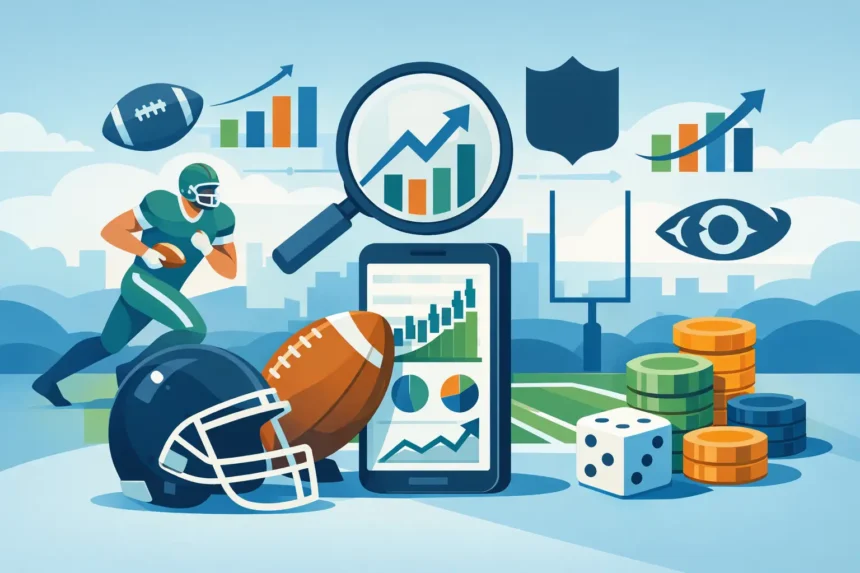
Week 1 lines still grab the headlines, but the real story sits underneath the board. NFL sports betting trends now move faster than ever because bettors are not just picking sides and totals anymore. They are reacting to injury news in real time, chasing player prop value, comparing same-game parlay pricing, and paying closer attention to how sportsbooks manage risk across the entire season.
- Why NFL sports betting trends matter more than ever
- Player props are no longer a side market
- Live betting keeps taking market share
- Same-game parlays are still booming, but price matters
- Market-making books influence the board faster
- Public betting is getting louder and less reliable as a fade signal
- NFL teasers still attract action, but books have adjusted
- Bettors are paying more attention to micro-data
- Sportsbooks are getting more selective with promos
- What to watch next
That shift matters for anyone trying to bet smarter. It also matters for anyone watching the business side of the market, because the NFL remains the engine room of US sports betting. Handle spikes, promo calendars tighten, product features get tested harder, and operators learn quickly what bettors actually want when football is back.
Why NFL sports betting trends matter more than ever
The NFL has always been the biggest regular-season betting product in the US, but the market around it is more mature now. In the early wave of legalization, sportsbooks competed heavily on sign-up offers and broad market access. That is still part of the picture, but the sharper battle is now about retention, pricing, speed, and product depth.
For bettors, that means more options and more traps. More markets can create more opportunity if you know how to compare prices and avoid overpaying for convenience. At the same time, heavily promoted bets, flashy boosts, and one-click parlays can pull attention away from the numbers that actually matter.
For operators, NFL betting is where product strategy becomes visible. If a sportsbook has weak live odds, stale prop markets, or poor cash-out logic, football season exposes it fast.
Player props are no longer a side market
A few years ago, player props felt like an add-on for engaged bettors. Now they sit near the center of NFL wagering behavior. Quarterback passing yards, anytime touchdown scorers, receptions, alt lines, and defensive stat props have become a major part of weekly betting menus.

There are a few reasons. Props are easier to personalize, which fits the way modern bettors follow fantasy football, social media clips, and player-specific narratives. They also create more content hooks. A bettor may not have a strong opinion on Jaguars vs. Colts against the spread, but may feel confident about a target share angle for a wide receiver.
The trade-off is pricing. Props often carry higher hold than traditional sides and totals, and casual bettors do not always shop around carefully enough. One book may hang a receiving total at 61.5 with standard juice while another posts 64.5. That gap matters. In a market where edges are already thin, line shopping is not optional.
Live betting keeps taking market share
One of the clearest nfl sports betting trends is the continued rise of live betting. NFL games are built for it. Frequent stoppages, high TV engagement, and constant data refreshes create a perfect environment for in-game wagers.
This is where bettor behavior has changed most. Instead of locking in a pregame card and watching passively, many players now treat Sunday as a rolling market. They wait for scripted opening drives, monitor red-zone efficiency, react to offensive line issues, and bet into live totals or next-drive markets based on how the game is actually unfolding.
There is real upside here, but it depends on discipline. Live betting can reward sharp observation, especially when a number overreacts to a turnover or a fluky early score. It can also become pure impulse if every possession turns into a new bet. Sportsbooks know this, which is why live interfaces are getting faster, smoother, and more prominent each season.
Same-game parlays are still booming, but price matters
Same-game parlays remain one of the biggest commercial stories in football betting. They are popular because they feel intuitive. Bettors can build a game script, tie together correlated outcomes, and create a higher payout from a small stake.
From the operator side, they are gold because they drive engagement and typically carry stronger margins. From the bettor side, they can be useful when the logic is sound and the pricing is fair. The problem is that many bettors focus on the story of the ticket more than the value of the legs.
A same-game parlay built around a passing-heavy script may make sense, but that does not mean it is priced well. Correlation can be an edge in some contexts, yet books are increasingly sophisticated in how they account for it. The market is much less forgiving than it was during the early adoption phase.
Market-making books influence the board faster
NFL markets now react to information almost instantly. Injury updates, weather reports, and lineup signals get priced in within minutes, sometimes seconds. That makes timing a bigger factor than many casual bettors realize.
If you are betting into major injury uncertainty, your edge often comes from predicting where the number will move before the market settles. If you are late, the best of the line is usually gone. This is especially true in player props, where limits can be lower and books move aggressively after respected action.
This also means bettors should think in terms of closing line value, not just outcomes. A ticket can lose and still be a good bet if it beat the market consistently. Over time, that matters more than celebrating a single result driven by variance.
Public betting is getting louder and less reliable as a fade signal
The old idea that you simply fade the public on NFL Sundays is too simplistic now. Public action still matters, especially in prime-time games and heavily televised spots, but the market is more efficient and more fragmented than that rule suggests.
There are more informed recreational bettors than there used to be. More people have access to analytics, injury reporting, and odds comparison tools. At the same time, sportsbook apps make it easier for public money to pour in quickly on familiar teams, star quarterbacks, and recent winners.
The better approach is to understand where public bias actually shows up. Overs in marquee games, favorite-heavy teaser cards, and touchdown props on star players can all attract inflated demand. But not every lopsided ticket count creates value on the other side. Sometimes the line is lopsided because the number is still cheap.
NFL teasers still attract action, but books have adjusted
Teasers remain a football-season staple, especially six-point NFL teasers that move favorites through key numbers or bring underdogs up through them. Bettors love them because they feel safer. The market loves them because they are familiar and easy to sell.
The issue is that not all teasers are created equal. Classic strategy around crossing key numbers still has logic, but pricing and house rules matter a lot more than casual bettors tend to notice. Reduced payout structures, leg restrictions, and market efficiency can weaken what once looked automatic.
This is one area where nostalgia can hurt. A betting concept that worked well in a different pricing environment may not offer the same edge now.
Bettors are paying more attention to micro-data
Another major shift in NFL sports betting trends is the use of team-level and player-level detail beyond basic stats. Pace, early-down pass rate, pressure rate, red-zone play calling, target share, and explosive play frequency now shape more betting decisions than raw win-loss records.
That is good for market quality. It forces a more informed conversation and helps separate surface narratives from actual performance indicators. It also raises the bar. If your handicap is built only on last week’s final score, you are often betting against a number that already reflects much deeper inputs.
Still, more data does not always mean better betting. The smart move is using a handful of meaningful indicators consistently, not drowning in dashboards and forcing a bet because you found a stat that sounds sharp.
Sportsbooks are getting more selective with promos
Football season still brings boosts, insurance offers, and odds specials, but the era of blanket generosity has cooled. As the market matures, operators are tighter with promo spend and more selective about who gets what.
That does not mean promotions are dead. It means bettors should read them more carefully. Wager caps, bonus bet expiration windows, market exclusions, and boosted lines that are not actually best price all matter. A promo can still be useful, but it should be treated like a pricing tool, not free money.
This change says a lot about where the industry is going. The acquisition race has slowed, and sportsbooks want more efficient player value during the most expensive part of the calendar.
What to watch next
The next phase of NFL betting will likely be shaped by faster in-game products, more personalized prop menus, and heavier use of automated pricing models. That should create a better front-end experience, but it may also make weak prices harder to find in obvious places.
For bettors, the path forward is less about finding magic systems and more about staying selective. Shop numbers. Understand hold. Be skeptical of highly marketed bets. Track your results by market type, not just by week. If one lesson keeps showing up across these trends, it is that the NFL betting market rewards attention and punishes autopilot.
That is the part worth remembering once the Sunday slate starts flying by. The smartest edge is often not a hot take on a team. It is knowing which markets deserve your money and which ones only want your attention.