

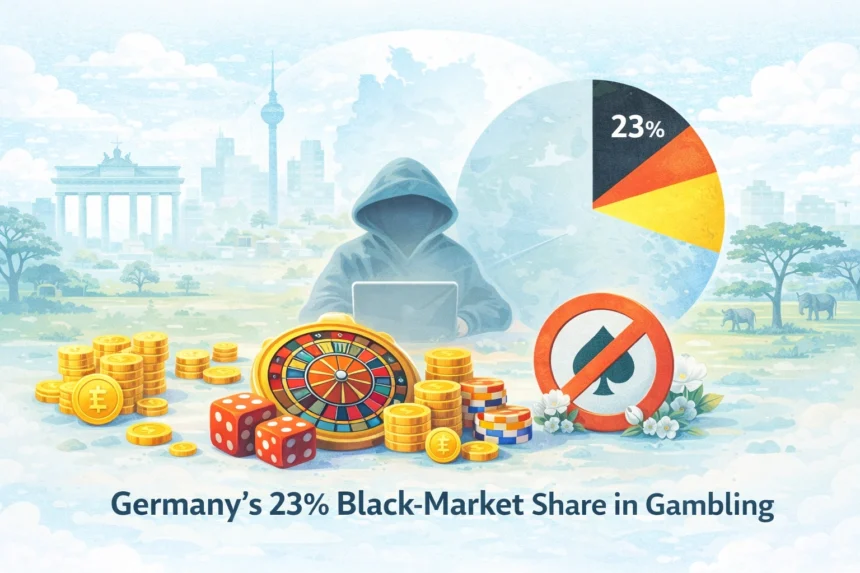
Germany has dropped one of the more important regulatory data points in Europe this week, with regulator-backed research estimating that illegal operators account for 22.97% of the country’s online gambling market, leaving licensed platforms with a 77.03% channelization rate.
That matters because “illegal market share” has become one of the most closely watched policy metrics in European gambling this year. It is no longer enough for regulators to say a market is licensed and supervised on paper. The real question is whether players are actually using the legal sites or slipping off to offshore operators anyway. Germany’s new figure gives regulators a clearer answer than before, even if not everyone will like the result.
Germany’s 23% Black-Market Share Is Big Enough to Matter, Small Enough to Fight Over
The study, commissioned by Germany’s gambling regulator and carried out by Blockchain Research Lab, estimates the illegal online market was worth about €547 million in 2024, up from €466 million in 2023. That means the black market is not marginal, even if the regulator now argues licensed operators still control most of the market.
That is exactly why the number is important. A black-market share of roughly 23% is low enough for regulators to argue that channelization is broadly working, but high enough for operators and critics to keep saying the legal market is still leaking too much demand offshore. In other words, it is the sort of figure that solves nothing politically while becoming very useful in arguments.
The debate is especially sharp in Germany because the country’s online market has been shaped by strict player-protection rules under the 2021 Interstate Treaty, including deposit limits and product restrictions. Licensed operators and trade bodies have repeatedly argued that some of those rules make legal offerings less competitive and risk pushing players toward unlicensed sites. The regulator’s new research pushes back against that narrative, at least partially, by saying most of the market is still staying inside the licensed system.

Why Channelization Has Become One of Europe’s Main Gambling Metrics
The bigger significance goes beyond Germany. Across Europe, regulators are increasingly judged not just by how tough their laws look, but by whether those laws actually steer players into the legal market. That is what channelization measures. If the legal share is high, regulators can argue that their framework is working. If the illegal share rises, operators immediately start arguing that the rules are too restrictive, the tax burden is too heavy, or enforcement is too weak.
Germany’s new figure lands right in the middle of that wider European fight. It gives the regulator a defensible line, roughly three-quarters of the market is legal, but it also leaves enough black-market activity on the table to keep the policy battle very much alive.
The bottom line is that Germany’s 22.97% illegal-market estimate matters less as a neat statistic than as a benchmark in the broader European struggle over channelization. It suggests the licensed market is winning more of the traffic than some critics claim, but it also confirms that the black market remains too large to dismiss. And in Europe’s current gambling debate, that percentage is no longer just a research finding. It is ammunition.