


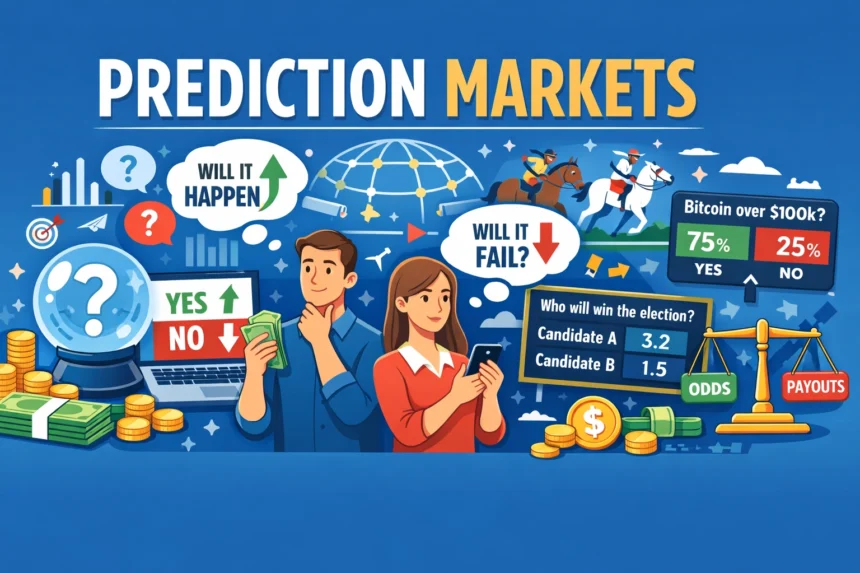
Prediction markets remain one of the most important legal and political stories in gambling-adjacent finance because the pressure is now coming from several directions at once.
Platforms such as Kalshi and Polymarket are facing a growing mix of court battles, state-level enforcement challenges, lawsuits, and possible federal policy changes, turning what once looked like a niche regulatory argument into a much broader fight over how these markets should be treated in the United States.
At the center of the debate is a question that still has no settled answer: are prediction markets primarily a form of financial trading, or are they drifting so close to gambling that regulators and lawmakers now feel compelled to step in more aggressively? That tension has existed for a while. What has changed is the temperature.
Court Fights and State Challenges Are Raising the Stakes
Kalshi has become the clearest legal flashpoint. In Massachusetts, a judge ruled that the company must stop offering sports-event contracts in the state unless it obtains a gaming license, rejecting Kalshi’s argument that federal commodities regulation overrides the state’s gambling authority. A related order gave the company 30 days to block those products in the state, making Massachusetts one of the sharpest examples yet of state regulators drawing a line against sports-event contracts.
That matters because it pushes the conflict beyond abstract theory. It shows that some states are prepared to treat prediction-market products as unlicensed sports wagering when they resemble ordinary bets closely enough. And once one state succeeds with that argument, others tend to pay attention.

Kalshi is also dealing with a class-action lawsuit tied to its handling of an Iran-related market, after users alleged the platform wrongfully refused to pay out contracts linked to the departure of Iran’s supreme leader. That dispute adds a second layer of pressure: even beyond the jurisdiction fight, prediction markets are now being tested in court over contract interpretation, fairness, and payout practices.
Polymarket is part of the same wider story, even if its legal posture differs. The company has become a frequent symbol in the broader debate over whether event-based trading products are becoming too speculative, too politically sensitive, or too close to gambling-style markets to avoid closer scrutiny. Reuters also noted that major exchange executives are now openly calling for clearer regulation as prediction markets grow, which shows the issue is no longer confined to crypto circles and legal specialists.
Federal Policy Pressure Is Starting to Build Too
The other reason this story has become more consequential is that the federal conversation is heating up as well. Reuters reported that Democratic lawmakers are drafting legislation aimed at tightening the rules around prediction markets after controversial trading tied to geopolitical events raised national-security and ethical concerns. That proposal may not become law quickly, but it is still significant because it shows prediction markets are moving from regulatory ambiguity into active political debate on Capitol Hill.
At the same time, Reuters reported in January that the Commodity Futures Trading Commission was moving toward issuing event-contract regulations, which suggests the federal rulebook itself may soon change. That creates another layer of uncertainty for platforms trying to scale while the boundaries of the business are still being written.
This is why the pressure on Kalshi and Polymarket feels broader than a normal compliance headache. It is not just one lawsuit, one state, or one regulator. It is a convergence of legal challenges, political criticism, and possible federal rulemaking, all hitting an industry that still likes to present itself as the future of forecasting rather than the cousin of sports betting.
The bottom line is that prediction markets are no longer operating in a comfortable grey zone. Kalshi and Polymarket now sit at the center of a much larger fight over jurisdiction, public policy, and market design. If the courts keep siding with states, lawmakers keep pushing for tighter controls, and federal regulators move toward more explicit rules, the sector may soon have a lot less room to define itself on its own terms. In other words, the market is still open, but the legal weather is getting worse.